I have been tossing up for awhile whether to post this article. As with my other essential oil safety posts, I understand that there may be some kind of back lash as it does tend to focus on MLM companies. However I feel that it is my duty as a certified aromatherapist to share essential oil safety information to help protect others.
All my essential oil safety posts are not intended to scare anyone about
using essential oils. Essential oils are regarded as safe when used
correctly. I am mostly just disappointed by the lack of safety
information that other essential oil distributors have to offer.
The examples that you will see below are only a minuscule amount of the unsafe recommendation posts that you may come across online. Many of these post are most worrying because they have the possibility to harm young children.
This post is not intended to be a stab at MLM companies, but sadly there is no denying that these types of posts only come from MLM reps. Certified aromatherapists generally won't post recipes online regarding blends for treating medical conditions as there are so many other factors to consider when helping to treat a client. I know there are MLM sellers that are trained correctly and don't post unsafe information. It's unfortunate that these mistakes reflect on those doing the right thing.
I strongly believe that there would be less of an issue if such companies educated their sellers on correct essential oil safety. The primary focus seems to be using as much essential oil as regularly possible and therefore requiring the need to purchase more. I have covered more on this in my other recent safety posts. These companies are giving the impression that their oils are 'therapeutic grade' and therefore that makes them safe to apply neat or ingest. Simply put, the term 'therapeutic grade' is actually just a registered trademark. Read more here.
Here is an example of the dilution recommendations on Doterra's website:

Doterra suggest on their website to apply a majority of their essential oils neat (undiluted) or use diluted at 1:3 (1 drop essential oil to 3 drops carrier) which is 33% approx. Their sensitive skin dilution amount suggests to dilute at 1:2 (50%). As you can see from the chart below, very few oils are listed as requiring dilution. They also suggest the ingestion of most of their oils. As an aromatherapist most topical applications only require a 3% dilution. Depending on a variety of factors, some blends that are to be used short term may be increased to 5-10% . I have covered more on this in my topical dilutions post.
I have contacted Doterra compliance regarding these safety concerns and I was told that I would receive a response from their Research & Development team. It's been a long time now and I have not heard back from them. I am more than happy to remove the above image if they update their topical dilution recommendations on their website and start promoting the safe use of essential oils.
This dilution chart suggest that these oils can be ingested (I) and applied neat (N):

Below are just some of the examples created & shared by essential oil sellers on social media sites such as Facebook, Instagram and Pinterest. I have outlined under each post why each example is considered 'unsafe' and in some cases what a safer recommendation would be. At the end of the article I have posted some examples of unfortunate side effects that have resulted from those relying on the incorrect and unsafe advice from untrained essential oil sellers.
WARNING: Be aware some of the graphics at the end of this article may be disturbing to some viewers.
I have blurred out the names to protect those who created the posts below. My only gain from posting this information is in the hope that it will make people more aware and take notice when it comes to following recommendations from untrained essential oil sellers. I am aware that some of the examples below may be very old posts. With people sharing, creating 'copy cat' blends or posting on sites like Pinterest it means that some post may never be removed from the internet. Another reason to be cautious with what you post, share or read on social media.
After discussing these concerns with MLM reps they tell me that these blends are considered as being 'Master Blends' and that you would make up that amount in a larger bottle and then dilute in a 10ml roller bottle. This definitely would be less concerning if that was the case and it was made clear on the shared posts. However I am finding this hard to believe considering not one of the posts that I have come across mentions anything about making up a master blend. As you will see they all generally suggest to add the drops of essential oil to a 10ml roller bottle and top with carrier oil.
EXAMPLES OF UNSAFE POSTS FOUND ON SOCIAL MEDIA
(click on images to view large version)
The examples that you will see below are only a minuscule amount of the unsafe recommendation posts that you may come across online. Many of these post are most worrying because they have the possibility to harm young children.
This post is not intended to be a stab at MLM companies, but sadly there is no denying that these types of posts only come from MLM reps. Certified aromatherapists generally won't post recipes online regarding blends for treating medical conditions as there are so many other factors to consider when helping to treat a client. I know there are MLM sellers that are trained correctly and don't post unsafe information. It's unfortunate that these mistakes reflect on those doing the right thing.
Here is an example of the dilution recommendations on Doterra's website:

Doterra suggest on their website to apply a majority of their essential oils neat (undiluted) or use diluted at 1:3 (1 drop essential oil to 3 drops carrier) which is 33% approx. Their sensitive skin dilution amount suggests to dilute at 1:2 (50%). As you can see from the chart below, very few oils are listed as requiring dilution. They also suggest the ingestion of most of their oils. As an aromatherapist most topical applications only require a 3% dilution. Depending on a variety of factors, some blends that are to be used short term may be increased to 5-10% . I have covered more on this in my topical dilutions post.
I have contacted Doterra compliance regarding these safety concerns and I was told that I would receive a response from their Research & Development team. It's been a long time now and I have not heard back from them. I am more than happy to remove the above image if they update their topical dilution recommendations on their website and start promoting the safe use of essential oils.
This dilution chart suggest that these oils can be ingested (I) and applied neat (N):

Below are just some of the examples created & shared by essential oil sellers on social media sites such as Facebook, Instagram and Pinterest. I have outlined under each post why each example is considered 'unsafe' and in some cases what a safer recommendation would be. At the end of the article I have posted some examples of unfortunate side effects that have resulted from those relying on the incorrect and unsafe advice from untrained essential oil sellers.
WARNING: Be aware some of the graphics at the end of this article may be disturbing to some viewers.
I have blurred out the names to protect those who created the posts below. My only gain from posting this information is in the hope that it will make people more aware and take notice when it comes to following recommendations from untrained essential oil sellers. I am aware that some of the examples below may be very old posts. With people sharing, creating 'copy cat' blends or posting on sites like Pinterest it means that some post may never be removed from the internet. Another reason to be cautious with what you post, share or read on social media.
After discussing these concerns with MLM reps they tell me that these blends are considered as being 'Master Blends' and that you would make up that amount in a larger bottle and then dilute in a 10ml roller bottle. This definitely would be less concerning if that was the case and it was made clear on the shared posts. However I am finding this hard to believe considering not one of the posts that I have come across mentions anything about making up a master blend. As you will see they all generally suggest to add the drops of essential oil to a 10ml roller bottle and top with carrier oil.
EXAMPLES OF UNSAFE POSTS FOUND ON SOCIAL MEDIA
(click on images to view large version)

SAFETY CONCERNS :
Essential oils should not be applied neat (undiluted) on infants. Very few oils should be used on infants. The essential oils in 'Digestzen' blend are not considered safe for use on infants. Read more of safe essential oils for babies here

Extremely strong & outrageous topical dilutions for children. Some close to being neat application. The 'peaceful child' blend suggests to use 190 drops of essential oil in a 10ml roller bottle blend.
RECOMMENDATIONS:
Essential oils should be diluted at 0.2% - 3% depending on the age of child. Most of these blends for children would not require more than approximately 6 drops total of essential oil. Read more here on how to calculate dilutions.

Strong & unnecessary dilution for daily face application.
RECOMMENDATIONS:
Generally a 1% dilution would be the maximum amount required for daily applications to the face. Even less would be sufficient.

Essential oils should not be ingested unless under the guidance of an Aromatic Medical Practitioner. This is also in my opinion an extremely large dose of essential oil per capsule to be taking 3 times a day. Considering the Thieves blend contains essential oils like eucalyptus, cinnamon and clove, this blend is extremely unsafe to be ingesting. Read more why ingesting essential oils is not recommended here.

85 drops total of essential oil in a 10ml roller is considered an unsafe dilution amount.
RECOMMENDATIONS:
Whilst I don't condone this blend, a 3% dilution (6-10 drops total) would suffice for this type of blend for adults.

Another example of an exceptionally strong topical dilution for use on children. Factors such as age specific dilutions are also not taken into consideration.

Studies suggest that boswellic acid found in frankincense resin may cure cancer. The issue here is that there is actually no boswellic acid found in Frankincense essential oil. This is a safety concern for people with cancer relying on the use of Frankincense essential oil instead of using other methods of treatment that may be more successful. More about Frankincense oil and cancer can be read here.

Another example of unsafe topical dilutions for children. Factors such as age specific dilutions are not taken into consideration.

I am not denying that it is better to use a glass instead of a polystyrene cup, but this post also has to make you wonder what the essential oil is gradually doing to your insides when ingesting daily and over a long period of time. For starters oil and water don't mix! The essential oils are not properly diluted when being added to water as the oil floats on top. Read more here.

Another example of unsafe topical dilutions for children. Although essential oils are natural it doesn't automatically make them safe. Many of these oils in these blends are considered unsafe for use on young children. Factors such as age specific dilutions are also not taken into consideration. At least they were wise in not suggesting to put essential oils inside the ear.

Another post recommending ingesting essential oils. This time to just add flavour.. oh and excitement! Essential oils used in the food industry for flavour are very different to those used for therapeutic use. Oils used in the food industry have had many of the chemical compounds removed. Read more on this here.

Peppermint used at a 50% dilution on infants is a serious safety concern. Applying oils neat is even worse. Thieves contains cinnamon and clove which is not recommended for use on babies. It seems from many of these posts it is presumed that because something is natural that it automatically makes it safe to use regardless of age or other factors.

80 drops of essential oil in a 10ml roller bottle for children or 5ml roller for adults. Need I say more?

And again, just look at the amount of essential oil drops recommended for kids.

Another unsafe 10ml roller bottle blend for children. Read more on essential oils safety for children here.

Drinking lemon essential oil in water is completely unnecessary. Some of the reasons being that our organs can not process copious amounts of these chemical constituents and they can build up in our system and cause failure over time. Ingestion can cause sensitisation and allergic reactions over long periods of time. Whilst I do feel there is a place for essential oils medicinally, they should only be ingested when prescribed by an aromatic medicine practitioner. Read more about ingesting essential oils here.

Here we see the unsafe 'peaceful child' blend again! I have noticed that this blend has been recreated and copied many times from different essential oil distributors. I believe I have seen at least 5 different graphics being shared with this same blend. For starters some of the oils are not recommended for use on young children. 85 drops of vetiver is just plain crazy! Personally when creating a blend I would use very little vetiver oil compared to other oils in the blend as it had a very strong, earthy and pungent odour.

Looks like the peaceful child blend again, except a slightly lower dilution (not by much). This post is not specific about whether it is for children or not, but even so it's still too strong for adults.

Examples of more strong roller bottle recipes. The post says to dilute 20-30 drops in a roller bottle for children. Whilst this is better than some of the other blends I have posted, it's still too strong for children. Applying essential oils to the skin at strong dilutions and regularly over time can cause skin sensitisation. That's why diluting correctly is so important.
RECOMMENDATIONS:
Essential oils should be diluted at 0.2% - 3% depending on the age of child. Read more on how to calculate dilutions correctly here

Count the drops! I think you all get the picture by now. Same blend and dilution for both children and adults.

As stated before it is not recommended to ingest essential oils without the advice of an Aromatic Medical Practitioner. Drinking this daily is an even bigger concern. Read more here.

There are a number of factors involved in making sunscreen that requires a cosmetic formulating background in addition to very specific equipment. Sunscreen companies invest millions of dollars formulating and testing sunscreens to ensure they are stable and effective. Oils can actually absorb light, making UV rays penetrate the skin more. Carrot seed oil in fact only contain approx 1-7 SPF. Read more here

As above. In this case I am also concerned with the application of sweet almond oil before going out in the sun as it is only considered to be SPF 5.

Never use essential oils internally by applying to a tampon. Applying essential oils this way can damage the mucous membranes and cause chemical burns in the vagina. The risks are too great and can be long lasting. I have included a story about the use of tea tree oil on tampons at the end of this article.

Clove is a harsh essential oil and not appropriate for use on babies, especially in the mouth! Clove contains phenols which is considered one of the most irritating essential oil constituents. Thieves blend contains both clove and cinnamon essential oil. To safely use cinnamon oil topically you would need one drop of oil to 50ml carrier oil. Certainly not safe for use inside the mouth of babes. Read more here

Same as above in that applying clove and thieves blend inside a babies mouth is not safe for their delicate gums.

You may have also seen a video lately with peppermint oil being used to remove a tick. It is not advised to use essential oils, dish soap etc to remove ticks as more toxic bacteria can be released into the bloodstream with these methods. Read more here.
RECOMMENDATIONS:
Always use a tick remover. Essential oils can however be used to repel ticks.
SIDE EFFECTS & INJURIES AS A RESULT OF BAD ADVICE
Injury resulting from neat application & using tanning bed :

Essential oil sensitisation looks like this - Severe allergic reaction and anaphylaxis direct result from years of essential oil over use :

Injury resulting from applying essential oils to a tampon :

Injury resulting from neat application & ingestion of essential oils :

Another example of why taking advice from social media isn't recommended :

Anytime you apply essential oils neat to your skin you run the risk of sensitisation. Once you become sensitised it's unlikely that you will be able to tolerate that essential oil ever again. Don't risk it!
Other Information Sources :
- Leslie Moldenauer - Essential Oil Safety Expert
- Robert Tisserand - Essential Oil Educator
- Top 10 worst injuries from essential oils
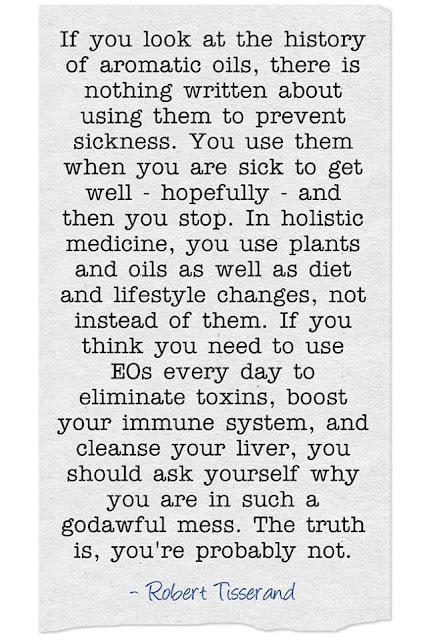
'Food for thought' about the over use of essential oils via daily ingestion :
Important : This information is for education purposes only. Always refer to an Aromatherapist or health care professional before using any essential oils to treat any medical conditions.
RELATED ARTICLES: